Domenic Bersch

PhD Student CVAI Lab, Goethe University Frankfurt

I am interested in how biological and artificial systems learn and represent visual information, and how we can use each to better understand the other.

  • Artificial Intelligence
  • Computational Neuroscience
  • Explainability
  • Computer Vision
  • Visual Cortex
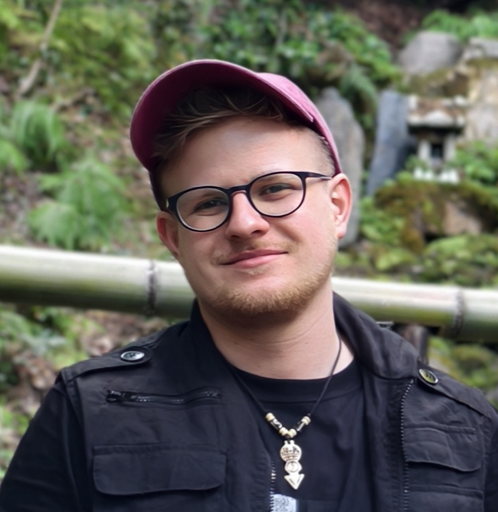
Portrait of Domenic Bersch

About

Who am I?

I am a PhD student at the CVAI Lab of Prof. Dr. Gemma Roig at Goethe University Frankfurt. My research focuses on understanding how biological and artificial systems represent and learn visual information. In particular, I work with brain encoding models and in silico neuroscience to study the relationship between deep neural networks and the human visual system.

Alongside this, I am interested in model interpretability and increasingly in continual learning, especially in understanding how different vision models learn and represent objects, context, and semantic information.

As part of this work, I contribute to projects such as Net2Brain and BERG, and I am involved in organizing the Algonauts Project challenge.

Recent News

What I have been up to.

Aug 2026

Algonauts Project Challenge 2027

We are excited to announce a new edition of the Algonauts Project Challenge, launching at the end of 2026 in collaboration with CNeuroMod. The challenge will be featured at CCN 2027 in Edinburgh. Stay tuned for more information!

Challenge page
Jul 2026

Spotlight paper at CCN 2026

Our paper “Vision Models Capture Complementary Representations in Children That Converge in Adults” was selected as a Spotlight Presentation at CCN 2026, and for a contributed talk in the Computational Psychiatry & Development session.

Session details
Jun 2026

Presenting BERG at CCN 2026

We are excited to present BERG as part of a keynote and tutorial at CCN 2026, showcasing how it can be used for in silico neuroscience.

Keynote & tutorial
Jan 2025

🎉 The Algonauts 2025 Challenge is now online!

The Algonauts Project 2025 challenge focuses on predicting human brain responses to complex multimodal movies. Important dates and features are now live!

Challenge website

Publications

Selected papers.

Newest first. Click a paper to read its abstract.

CCN 2026 2026 Spotlight Contributed Talk

Vision Models Capture Complementary Representations in Children That Converge in Adults

Domenic Bersch, Timothy Schaumlöffel, Michela Proietti, Antonia Franaszek-Traczewska, Hannah Elisabeth Zwad, Siying Xie, Marlena Baldauf, Teresa Sylvester, Christina Maria Schätz, Moritz Köster, Stefanie Höhl, Bert Turtleton, Radoslaw M. Cichy, Gemma Roig

Abstract
How the relationship between image-text aligned and vision-only models changes across development remains unknown. To address this, we applied time-resolved representational similarity analysis to EEG data from 8-year-olds, 12-year-olds, and adults. Commonality analysis showed complementary structure for image-text aligned versus vision-only models at 8 years, near-zero shared variance at 12 years, and greater overlap in adults, while both retained unique variance at all ages. This pattern generalized across model pairings, whereas vision-only model pairs showed overlapping variance at every age, suggesting a double dissociation. Within-category structure appeared complementary even in adults, suggesting that image-text aligned training may capture fine-grained structure not recovered by vision-only training. Together, these findings suggest that image-text aligned and vision-only models capture distinct aspects of visual representations that become more aligned in adulthood, and that vision-only models alone may miss structure relevant for developmental model-brain alignment.
CCN 2025 2025

Catalyzing in silico neuroscience with a toolkit of accurate encoding models of the brain

Alessandro T. Gifford, Domenic Bersch, Gemma Roig, Radoslaw M. Cichy

Abstract
In silico neural responses generated from encoding models increasingly resemble in vivo responses recorded from real brains, enabling the novel research paradigm of in silico neuroscience. In silico neuroscience scales beyond what is possible with in vivo data, allowing to explore and test scientific hypotheses across vastly larger solution spaces. To catalyze this emerging research paradigm, here we introduce the Brain Encoding Response Generator (BERG), a resource consisting of multiple pre-trained encoding models of the brain and a Python package to generate accurate in silico neural responses to massive amounts of arbitrary stimuli with a few lines of code. We show that BERG's encoding models accurately predict neural responses to visual stimuli, and that these in silico responses reproduce key neural signatures of visual processing in the brain. Together, this opens the doors to using in silico neural responses for scientific discovery, which we envision will lead to a more efficient and reproducible science.
arXiv 2025

The Algonauts Project 2025 Challenge: How the Human Brain Makes Sense of Multimodal Movies

Alessandro T. Gifford, Domenic Bersch, Marie St-Laurent, Basile Pinsard, Julie Boyle, Lune Bellec, Aude Oliva, Gemma Roig, Radoslaw M. Cichy

Abstract
There is growing symbiosis between artificial and biological intelligence sciences: neural principles inspire new intelligent machines, which are in turn used to advance our theoretical understanding of the brain. To promote further collaboration between biological and artificial intelligence researchers, we introduce the 2025 edition of the Algonauts Project challenge: How the Human Brain Makes Sense of Multimodal Movies. In collaboration with the Courtois Project on Neuronal Modelling (CNeuroMod), this edition aims to bring forth a new generation of brain encoding models that are multimodal and that generalize well beyond their training distribution, by training them on the largest dataset of fMRI responses to movie watching available to date.
Frontiers in Neuroinformatics 2025 Oral at VSS

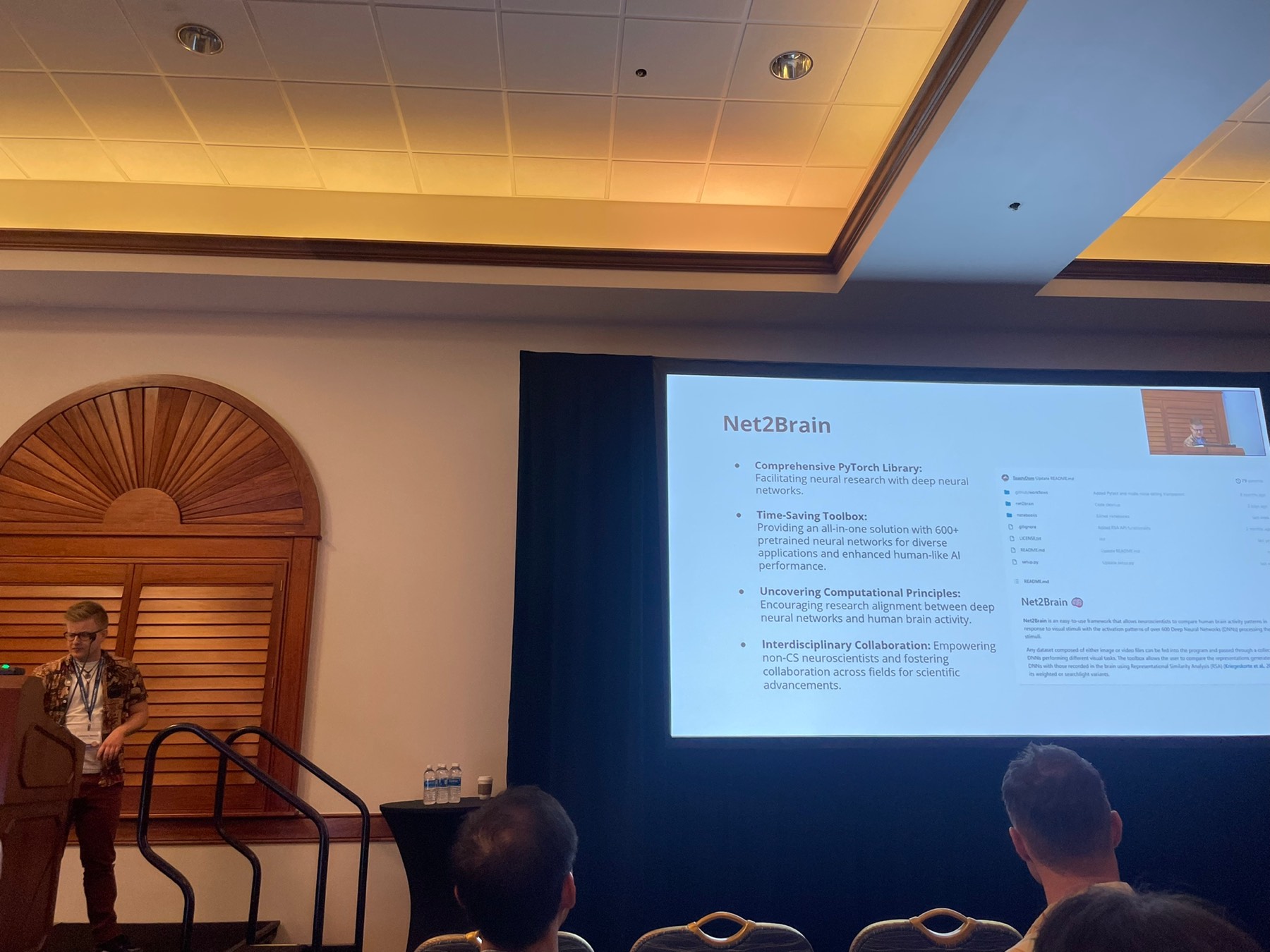
Net2Brain: A Toolbox to Compare Artificial Vision Models with Human Brain Responses

Domenic Bersch, Kshitij Dwivedi, Martina Vilas, Radoslaw M. Cichy, Gemma Roig

Abstract
We introduce Net2Brain, a graphical and command-line user interface toolbox for comparing the representational spaces of artificial deep neural networks (DNNs) and human brain recordings. Net2Brain supports activations from over 600 DNNs trained on diverse vision-related tasks (e.g., semantic segmentation, depth estimation, action recognition), for both image and video datasets. It computes representational dissimilarity matrices (RDMs) from activations and compares them to brain recordings using representational similarity analysis (RSA), weighted RSA, and searchlight search. The toolbox also allows integration of new stimuli and brain recording datasets. An example demonstrates its utility for testing cognitive computational neuroscience hypotheses.

Projects

Things I work on.

Open tools and resources I build and maintain.

The Algonauts Project

Lead Organizer

Algonauts Project Challenge 2027

The next edition of the challenge, organized in collaboration with CNeuroMod. It will launch at the end of 2026, with the challenge featured at CCN 2027 in Edinburgh. More information will be announced over the coming months.

BERG

Lead Developer

BERG

The Brain Encoding Response Generator is a collection of pre-trained brain encoding models and a Python package for generating in silico neural responses to arbitrary stimuli. It makes it easy to run large-scale in silico neuroscience experiments across different datasets, subjects, brain regions, and recording modalities.

Net2Brain

Lead Developer

Net2Brain

A toolbox for comparing representations from deep neural networks with human brain data. It provides access to over 600 pre-trained models and supports common neural comparison methods such as RSA, weighted RSA, and searchlight analysis, while also allowing researchers to integrate their own models.

The Algonauts Project Challenge 2025

Co-Organizer

Algonauts Project Challenge 2025

The 2025 challenge focuses on multimodal brain encoding models that generalize beyond their training distribution. In collaboration with CNeuroMod, it uses the largest fMRI movie-watching dataset available to date and brings together the neuroscience and machine learning communities.

Sharing my work

Keynotes, tutorials & talks.

Presentations from conferences, workshops and tutorials.

Contributed Talk CCN 2026 6 August 2026

Vision Models Capture Complementary Representations in Children That Converge in Adults

Skirball Theater, New York University, New York, NY

Details
Selected as a Spotlight Presentation and presented in the Computational Psychiatry & Development contributed talk session. Using time-resolved RSA with EEG from 8-year-olds, 12-year-olds, and adults, we found that image-text aligned and vision-only models capture complementary aspects of visual representations during childhood, with their relationship becoming more similar in adults. In particular, image-text aligned models showed a stronger advantage in children than in adults.
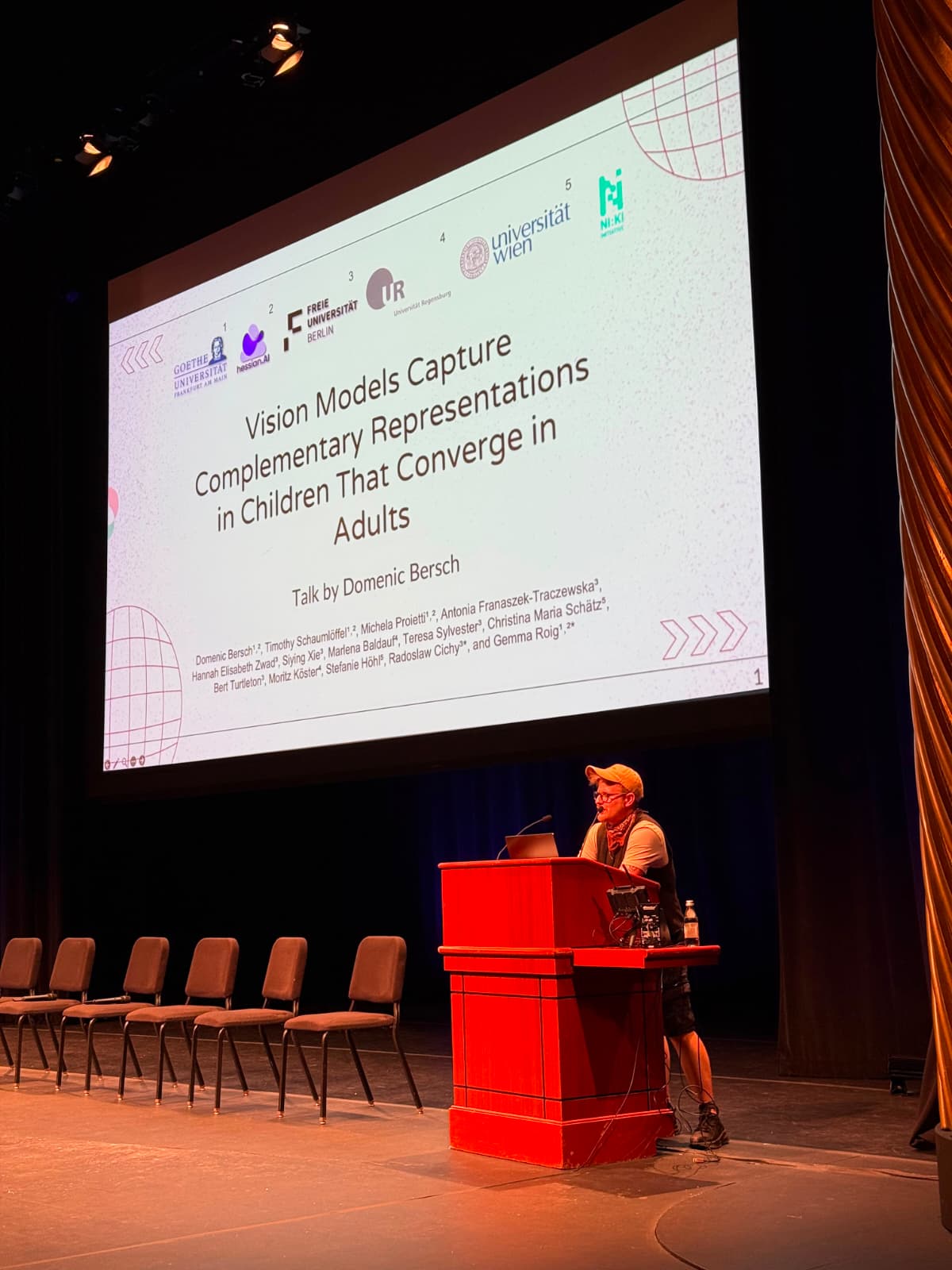
Domenic Bersch presenting the paper at CCN 2026, Skirball Theater
Presenting at CCN 2026, Skirball Theater, New York University.
Keynote & Tutorial CCN 2026 3 August 2026

In silico neuroscience: an emerging paradigm for brain discovery

Skirball Theater, New York University, New York, NY

Details
This keynote and tutorial introduces in silico neuroscience as an emerging paradigm for brain discovery. We discuss how pretrained brain encoding models can be used to generate neural responses at scale, enabling researchers to explore and test hypotheses before targeted in vivo validation. In the hands-on tutorial, participants use BERG to generate in silico fMRI responses, test known properties of visual cortex, and run interactive experiments exploring visual selectivity across the brain. Presented with Alessandro Gifford.
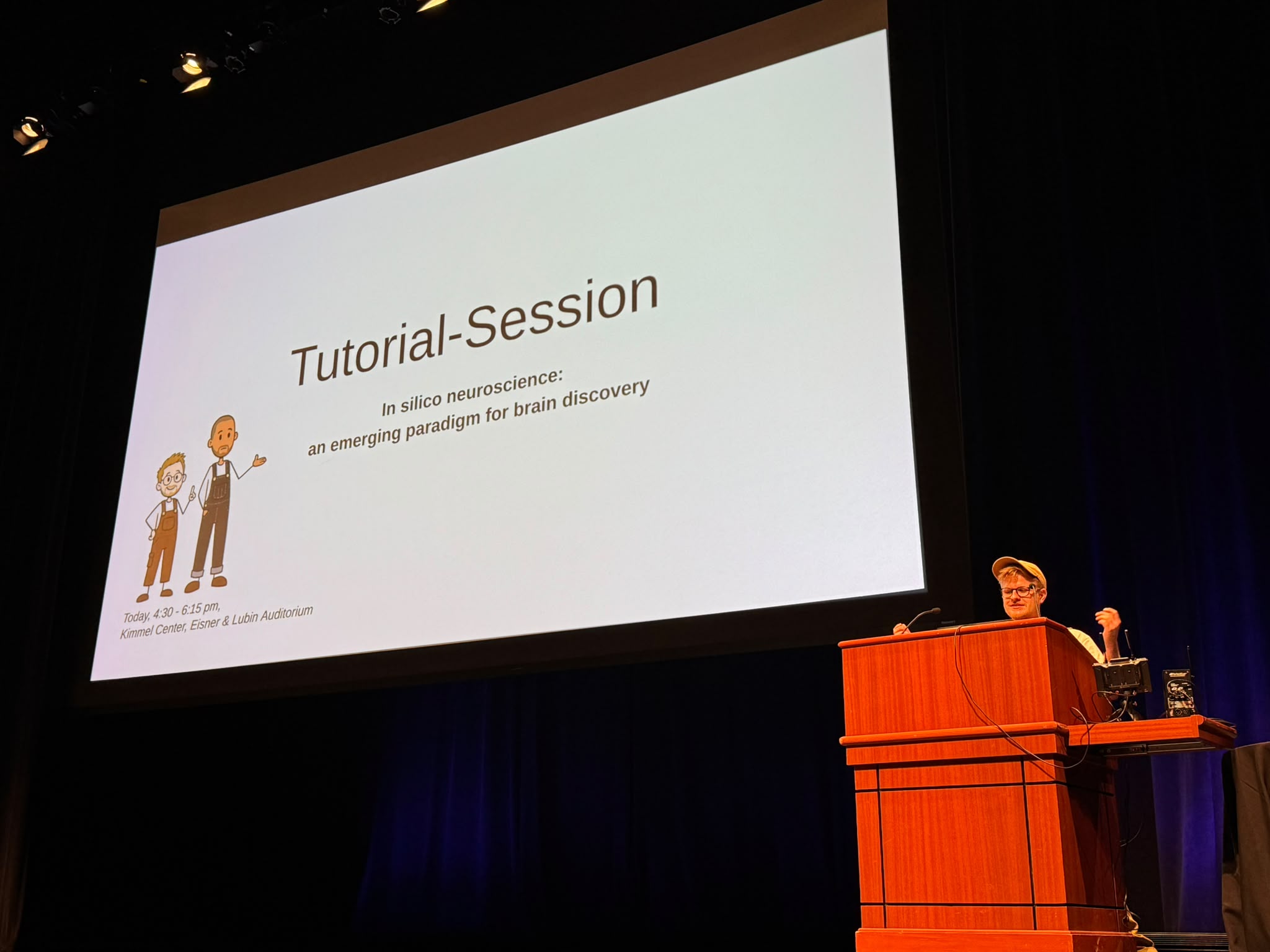
Domenic Bersch opening the tutorial session at CCN 2026
Introducing the tutorial session at CCN 2026, New York University.
Online School Neuromatch Academy July 2026

Algonauts 2025 Tutorial for Neuromatch Academy

Online

Details
We prepared a simplified version of the Algonauts 2025 Challenge for Neuromatch Academy. The tutorial introduces students and early-career researchers to working with neuroscientific data, multimodal movie stimuli, and brain encoding models. Our goal was to make this type of data more accessible by providing an approachable Colab notebook and tutorial video that guide participants through the basic ideas behind predicting brain responses from visual, audio, and language features.
Award Ceremony Host Cognitive Computational Neuroscience 2025 12–13 August 2025

Algonauts 2025 Challenge Award Ceremony

Universiteit van Amsterdam, Amsterdam, Netherlands

Details
The award ceremony of the Algonauts 2025 challenge, “How the Human Brain Makes Sense of Multimodal Movies”. The ceremony featured presentations from the winners of this year's challenge, highlighting their innovative methods for understanding multimodal processing in the human brain, followed by an interactive Q&A session with the challenge participants.
Talk & Tutorial PhD Kolloquium 2024 3 October 2024

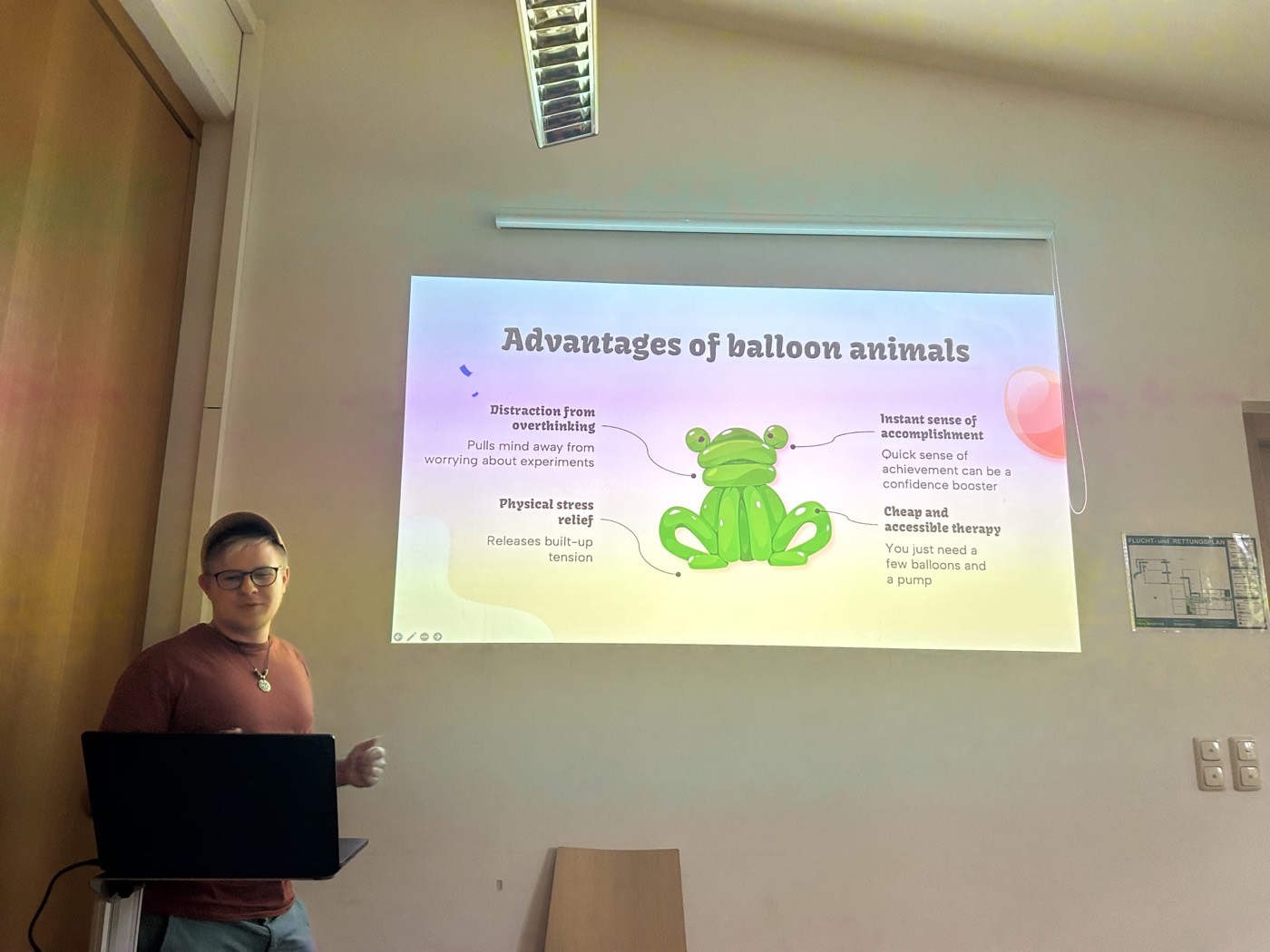
🎈 Balloonanimals — Deflating PhD Stress

Haus Bergkranz, Hirschegg, Austria

Details
This groundbreaking presentation and tutorial session introduces balloon animals as the premier solution for PhD-related stress management. I demonstrate how the creation of dogs, swords, swans, and many more animals provides immediate dopamine boosts and stress relief. Inflate your joy while deflating your anxiety!
Domenic Bersch presenting on balloon animals at the PhD Kolloquium 2024
Explaining the advantages of balloon animals, Haus Bergkranz, Austria.
Invited Speaker Cognition Academy Cohort 2024 23 July 2024

Unveiling cognitive properties of brain representations + Algonauts hands-on tutorial

Schloss Eckberg, Dresden, Germany

Details
This workshop explores how artificial neural networks can help us understand information processing in the brain. Starting with theoretical foundations of modern cognitive neuroscience methods, including representational similarity analysis and encoding models. Then, through two hands-on tutorials, participants apply these concepts to real data: first, using the Algonauts 2023 challenge to predict brain responses in visual areas, and second, analyzing fMRI patterns of people reading Harry Potter to understand how our brains process language.
Oral Presentation Vision Sciences Society 2023 23 May 2023

Net2Brain — A toolbox to compare artificial vision models with human brain responses

TradeWinds Resort, St. Pete Beach, FL, United States

Details
We introduce Net2Brain, a graphical and command-line user interface toolbox for comparing the representational spaces of artificial deep neural networks (DNNs) and human brain recordings. Net2Brain supports activations from over 600 DNNs trained on diverse vision-related tasks, for both image and video datasets. It computes representational dissimilarity matrices from activations and compares them to brain recordings using RSA, weighted RSA, and searchlight search. An example demonstrates its utility for testing cognitive computational neuroscience hypotheses.
Domenic Bersch presenting Net2Brain at the Vision Sciences Society 2023 meeting
Presenting Net2Brain at VSS 2023, TradeWinds Resort, St. Pete Beach.